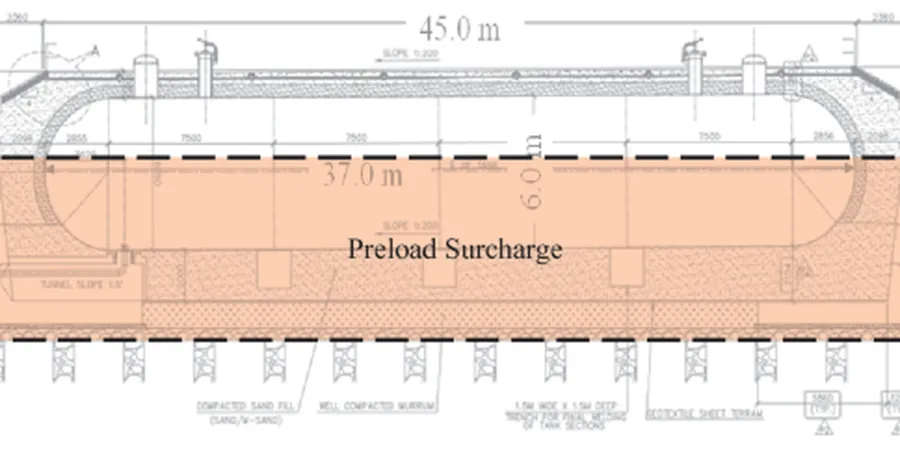
Fremont's subsurface is dominated by Young Bay Mud, a soft clay deposit up to 80 feet thick in some areas of the city. For projects requiring foundations on these compressible soils, preloading with surcharge design follows the consolidation framework of Terzaghi and the latest ASCE 7 requirements. We design the surcharge height and duration based on consolidation tests from undisturbed samples. The goal is to achieve the required degree of consolidation before construction. This approach works well for warehouses, parking lots, and embankments. We often combine this design with a study of vertical drains to accelerate pore pressure dissipation when schedule is tight. Without this step, long-term settlement can exceed tolerable limits.
For Fremont sites underlain by Bay Mud, staged surcharge with monitoring cuts long-term settlement by more than half compared to untreated ground.
Methodology and scope
Fremont grew rapidly from the 1960s onward, converting former marshlands into industrial parks and residential subdivisions. That history means many sites sit on deep soft clay. Our preloading with surcharge design accounts for the staged construction sequence typical of Bay Area projects. We first install monitoring instrumentation like settlement plates and piezometers. Then we place the fill in lifts, measuring pore pressure response at each stage. The design uses the coefficient of consolidation (Cv) from oedometer tests on undisturbed tube samples. We also evaluate the preconsolidation pressure to avoid overstressing the foundation soil. A key refinement is the use of a plate load test on the preloaded surface to verify stiffness before final construction begins. This gives the owner hard data on remaining settlement potential.
Technical reference image — Fremont
Local considerations
The main risk in Fremont is underestimating the settlement rate of the soft clay. We use settlement platforms with automated data loggers to track movement daily. A second risk is lateral squeeze under the surcharge — we check the factor of safety using slip circle analysis. If the safety factor drops below 1.3, we widen the surcharge footprint or add berms. Another concern is differential settlement at utility connections. We design transition zones with tapered surcharge thickness. Proper monitoring reduces these risks to acceptable levels.
We calculate the required surcharge height, fill type, and placement sequence to achieve 90% primary consolidation within your project schedule. Deliverables include fill lift thickness, compaction criteria, and a monitoring plan.
02
Instrumentation & Monitoring
We install settlement plates, pneumatic piezometers, and inclinometers to measure real-time ground response under the surcharge. Data is reported weekly with updates on remaining settlement and pore pressure dissipation.
03
Post-Preload Verification Testing
After surcharge removal, we perform plate load tests and CPT soundings to confirm the improved modulus and bearing capacity. This gives the structural engineer confidence to proceed with shallow foundations.
Applicable standards
ASCE 7-22 Minimum Design Loads (consolidation settlement criteria), IBC 2021 Chapter 18 (soil improvement and fill placement), ASTM D2435 (one-dimensional consolidation properties), ASTM D1586 (SPT for site characterization in overburden)
Frequently asked questions
How long does preloading with surcharge typically take in Fremont?
For Bay Mud deposits 20 to 40 feet thick, achieving 90% consolidation usually takes 6 to 10 months under a surcharge of 12 to 16 feet. The exact duration depends on the clay's consolidation coefficient and drainage path length.
What is the cost range for a preloading with surcharge design in Fremont?
The design and monitoring scope typically ranges between US$930 and US$2,170 for a standard commercial pad site. This includes field instrumentation, laboratory consolidation testing, and the final settlement analysis report.
Do I need vertical drains with surcharge in Fremont?
Vertical drains (PVDs) are recommended when the clay layer exceeds 30 feet or when the construction schedule is shorter than 8 months. Drains reduce the drainage path length and accelerate consolidation by a factor of 2 to 4.
What settlement should I expect after surcharge removal?
With proper design, post-construction settlement is typically less than 1 inch over 10 years for loads up to 300 psf. We calculate this using the compression index from oedometer tests and the final applied load.
Can I build a shallow foundation after preloading?
Yes, provided the preloading achieves at least 90% primary consolidation and a plate load test confirms a modulus of subgrade reaction above 100 pci. We then design spread footings per IBC Chapter 18 with a net bearing pressure of 2,000 to 3,000 psf.