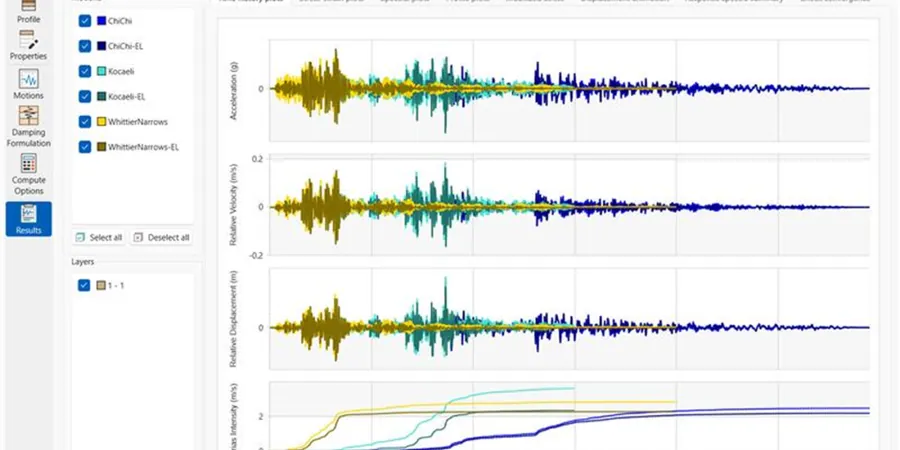
Fremont sits on deep alluvial deposits and Bay Mud, conditions that amplify earthquake ground motions significantly. Under ASCE 7-22, site class E or F applies across much of the city, requiring a measured Vs30 rather than default values. Our team runs MASW arrays per ASTM D4428 to capture shear-wave velocity profiles. Data feeds directly into site-specific response spectra. For projects near the Hayward Fault, we combine this with deep soil mixing to stabilize liquefiable layers before analysis. The result is a defensible design basis that avoids over-conservatism or unsafe assumptions.
Measured Vs30 in central Fremont ranges from 180 to 250 m/s, classifying most parcels as Site Class E under ASCE 7.
Methodology and scope
We deploy a 24-channel seismograph with 4.5 Hz geophones spaced at 3 m intervals, recording 2-second passive wavefields. The MASW survey covers 150 m spreads to reach bedrock depth. Our processing extracts Rayleigh-wave dispersion curves inverted via genetic algorithms to build Vs profiles. We then compute site coefficients Fa and Fv per ASCE 7. In soft clay zones near the Dumbarton Bridge, we cross-check with CPT soundings to validate the stiffness profile. Key parameters we output:
Technical reference image — Fremont
Local considerations
Fremont's urban growth since the 1960s filled former marshlands along the Bay. These artificial fills and soft Holocene clays amplify long-period motions, endangering mid-rise structures on shallow foundations. During the 1989 Loma Prieta earthquake, parts of the city experienced 2–3 times higher shaking than adjacent bedrock sites. Without a proper seismic amplification analysis, buildings on these deposits may experience resonance with the ground's natural period, leading to drift damage or collapse. Our analysis identifies these risks before foundation design.
Active and passive surface-wave surveys using 24-channel arrays to measure shear-wave velocity to 30 m depth. Suitable for sites with limited access or high ambient noise.
02
Site-Specific Response Spectra
Develop acceleration response spectra for the design earthquake (MCE_R) using measured Vs30, site class, and regional attenuation relationships per ASCE 7.
03
Liquefaction Hazard Screening
Combine seismic amplification results with SPT blow counts and fines content to evaluate liquefaction triggering potential under design shaking levels.
How does seismic amplification analysis differ from a standard soil report?
A standard soil report provides bearing capacity and settlement parameters. Seismic amplification analysis specifically quantifies how the soil column modifies earthquake ground motions. We measure shear-wave velocity (Vs30) and compute site coefficients Fa and Fv per ASCE 7. This produces site-specific response spectra for structural design, which a conventional geotechnical report does not include.
What is the typical cost for a seismic amplification analysis in Fremont?
Costs range between US$1,120 and US$2,230 depending on site size, number of MASW lines, and whether passive array data is needed. A single-family lot with one active spread falls at the lower end. A multi-acre commercial parcel requiring two or three lines plus passive HVSR runs at the higher end.
Do I need this analysis for a small residential addition?
Fremont building code requires site-specific seismic analysis for Risk Category III and IV structures (schools, hospitals, emergency facilities). For single-family homes, the IBC allows default site class D unless the geotechnical engineer identifies soft conditions. If your lot is within 500 ft of the Bay or mapped as fill, we recommend the analysis to avoid costly over-design or future retrofit.