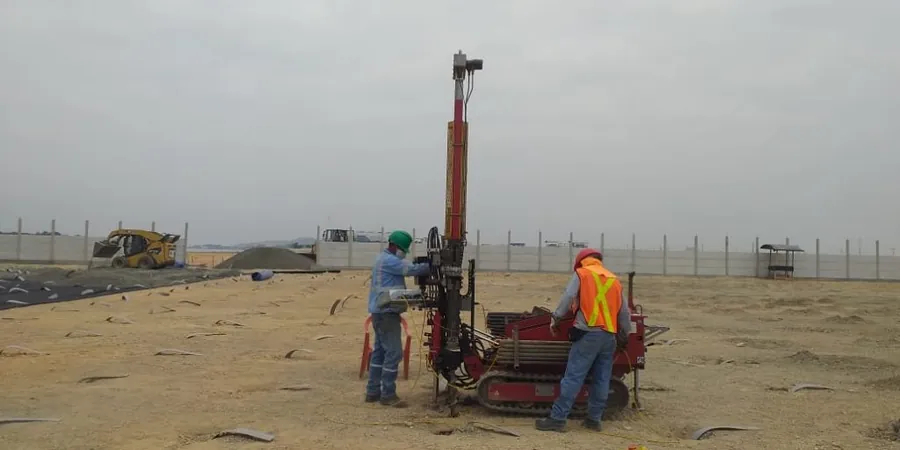
Fremont grew fast from its orchard days into a tech hub, and that urban shift changed the ground story. The alluvial fans and old marsh deposits under the city create variable soil conditions that demand careful evaluation. We perform settlement analysis in Fremont to understand how much and how fast the ground will compress under load. Before a foundation goes in, we run consolidation tests and correlate them with field data from a geotechnical borehole to capture the full profile. The results feed directly into foundation design, slab thickness, and load distribution. Without that data, you risk cracks, tilting, or structural damage years later.
Differential settlement in Fremont's bay muds can exceed one inch if preconsolidation pressure is misjudged. That is not a theory — we have seen it on site.
Methodology and scope
Fremont sits about 52 feet above sea level, but much of its soil profile consists of young alluvium and bay muds that are highly compressible. We combine lab consolidation testing per ASTM D2435 with field methods like plate load testing to calibrate settlement predictions. The parameters we track include:
Compression index (Cc) and recompression index (Cr)
Preconsolidation pressure (σ'p) to identify overconsolidation ratio
Coefficient of consolidation (Cv) for time-rate estimates
Secondary compression (Cα) for long-term creep in organic layers
These values allow us to model total and differential settlement under service loads. The goal is always to match the predicted settlement with the project's tolerance limits.
Technical reference image — Fremont
Local considerations
The coastal humidity in the Bay Area keeps soil moisture high year-round, which slows consolidation and extends the settlement period. In Fremont's older fill zones, we have logged up to 3 inches of post-construction settlement when the preload was insufficient. Combining settlement analysis with an infiltration test helps separate drainage-controlled settlement from load-controlled compression. The real risk appears when differential movement exceeds structural tolerances — doors jam, slabs step, and utility lines break. We flag those thresholds early so the design team can adjust foundation type or add ground improvement.
Incremental load oedometer tests to determine Cc, Cr, σ'p, and Cv. Results are used to plot time-settlement curves and estimate total settlement under proposed loads. We report both immediate and primary consolidation phases.
02
Differential Settlement Risk Assessment
We compare predicted settlement across foundation elements using soil variability data from multiple boreholes. The output includes contour maps of expected differential movement and recommendations for foundation stiffness or ground improvement.
Applicable standards
ASTM D2435 (Standard Test Methods for One-Dimensional Consolidation of Soils), ASTM D4186 (Oedometer with Pore Pressure Measurement), ASCE 7-22 (Minimum Design Loads and Associated Criteria for Buildings), IBC 2021 (Chapter 18 — Soils and Foundations)
Frequently asked questions
What is the typical range of settlement you see in Fremont's alluvial soils?
For structures on shallow foundations, total settlement often falls between 0.5 and 2.5 inches in clayey silt layers. Differential settlement can reach 0.5 to 1.0 inch if the soil profile changes across the site.
How long does it take for primary consolidation to finish in Fremont?
In the younger bay muds, 90% consolidation can take 12 to 24 months. For the older alluvium with lower plasticity, that period shortens to 6 to 12 months. We model time-rate curves per ASTM D2435 for each layer.
What is the cost of a settlement analysis study in Fremont?
The typical cost ranges between US$690 and US$1,920 depending on the number of consolidation tests, borehole depth, and reporting detail. For a standard 3-borehole project with 6 consolidation tests, expect around US$1,200.
Do you account for secondary compression in organic layers?
Yes. Organic silt and peat layers exist in parts of Fremont near the bay. We measure Cα from long-term creep tests and include it in the total settlement projection. Ignoring secondary compression can underestimate final settlement by 20 to 40 percent.